 Caprock Mold Pros
If you smell something musty and you cannot find it, you need a mold inspection. Caprock Mold Pros connects you with mold inspection and testing contractors in Lubbock, TX and across the South Plains. A contractor comes out, looks, takes moisture readings, and tells you straight what is going on. The visual inspection is free. If you need lab testing on top of that, the cost is explained before any sample is collected.
Here is what most folks in Lubbock get wrong about mold. They think this is a Houston problem. Dry climate, low humidity, dust instead of damp. So when they see a dark spot on the drywall they assume it is dirt, or a scuff, or something the kids did. It sits there for a year.
Mold in West Texas does not come from the air. It comes from water that got somewhere it should not be. A supply line under a sink. A hail-beat roof that started letting water past the flashing. An evaporative cooler line that drips inside a wall cavity. A slab leak. The outside air here is dry as a bone. The inside of that wall is not.
If you can smell it, there is enough moisture in that wall to grow it. Smell is not proof of a health hazard. It is proof of a water problem. Both need fixing.
What a Real Mold Inspection Involves
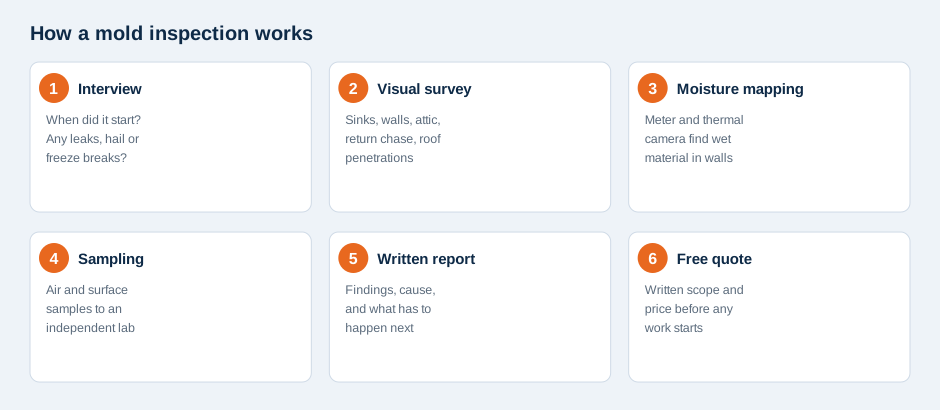
An inspection is not a guy sticking his head in a closet and quoting you a number. Here is what contractors actually do.
A contractor talks to you first
Before opening anything, a contractor asks questions. When did you first notice it. Has anything leaked. Did you have a pipe break in a freeze. Did you take hail and file a claim. Has anyone had a cough that will not quit, or headaches that stop when they leave town. That conversation usually narrows it down to within ten feet of the problem.
Visual inspection, top to bottom
Contractors check the obvious places and then the places people never look. Under sinks. Behind the toilet base. Along the bottom plate of exterior walls. Inside the return air chase. Behind baseboards on the wall that shares plumbing with the bathroom. At the roof deck in the attic, especially the north slope and around every penetration. Around the evaporative cooler duct drop if you have one.
Moisture mapping
This is the part that separates an inspection from a guess. Contractors use a moisture meter and a thermal camera to find wet material behind finished surfaces. Drywall that reads high is drywall that is feeding something. Thermal shows the shape of the wet area, which shows where the water is coming from. A slab leak looks different from a roof leak. A condensation problem looks different from both.
The reason this matters: moisture travels. The stain is rarely directly under the leak. A slab leak in a hall bathroom shows up as a soft spot in a bedroom closet twelve feet away, because water follows the path the concrete gives it. People cut open the wrong wall all the time.
Sampling, when it is needed
Not every job needs a lab test. If there is a two-foot patch of black growth under your kitchen sink, a lab is not needed to know what to do. The leak needs to be killed and the material removed. Testing matters when growth is hidden, when you are in a dispute with a landlord or an insurer, when somebody in the house is sick and you need documentation, or when you need clearance after remediation. Air samples get compared against an outdoor control. Surface samples come off with a tape lift or a swab. Everything goes to an independent lab.
A written report
You get a document. Where the moisture is, what it appears to be, what caused it, what has to happen, and in what order. Written so you can hand it to an insurance adjuster, a property manager, or a real estate agent without translating it.
Why Lubbock Homes Grow Mold in a Dry Climate
Lubbock sits up on the Llano Estacado at about 3,200 feet, right on the Caprock, with average annual rainfall in the neighborhood of nineteen inches. It is genuinely dry. That is exactly why people here ignore mold until it is bad.
Four things drive nearly every mold job contractors see on the South Plains.
Plumbing leaks under slab-on-grade construction
Most homes in Lubbock are built slab-on-grade. There is no crawl space to catch a leak and no basement to inspect. Water lines run through or under that slab. When a line fails, the water has nowhere to go but sideways and up. It wicks into the bottom of the drywall, into the tack strip, into the pad under the carpet. You may never see standing water. You will smell it in about three weeks.
The soils make it worse. Caliche and expansive clay move with moisture. That movement stresses supply lines and drain lines and cracks slabs, which is how a small leak turns into a real one.
Hail damage to roofs
The South Plains sits in one of the highest hail-frequency corridors in the country. Spring storms roll through March into June and put golf-ball hail on roofs across Lubbock County on a regular basis. Plenty of those roofs get replaced. Plenty do not, because the damage was not obvious from the ground or the claim got denied.
A bruised shingle does not leak the day of the storm. It leaks eight months later during a slow soaking rain. That water runs down the decking, soaks the insulation, and starts a colony in the attic where nobody is looking. See attic mold removal in Lubbock.
Hard freezes and burst pipes
Lubbock gets hard freezes. Every few winters one is bad enough to break pipes across the whole city at once. February 2021 was the obvious one, but it happens on a smaller scale most winters. Exterior wall plumbing, hose bibs, garage lines and attic runs are the usual failures.
The mold job does not come from the burst. It comes from the repair. A plumber fixes the pipe, somebody runs a box fan for two days, the carpet feels dry, everyone moves on. The wall cavity and the bottom plate never got dried. That shows up as mold in April.
Evaporative coolers and HVAC condensation
Swamp coolers are common here for good reason. They work well in dry air and they are cheap to run. They also put a lot of moisture into a house on purpose. Run one with the windows shut, or run one in a house that has been tightened up with new windows and insulation, and the humidity has nowhere to go. It condenses on the coldest surfaces available: north-facing exterior walls, closet corners, behind furniture pushed against an outside wall.
Refrigerated air has its own version. A clogged condensate drain, a rusted-through pan, or a unit oversized for the house that short-cycles and never pulls humidity out. Attic air handlers are the worst offenders because the drip lands on ceiling drywall and spreads before anyone sees a stain.
When You Should Test and When You Should Not
Contractors will tell you when you do not need testing. That is not a sales technique. Testing costs money, and if the answer will not change what you do, skip it.
Test when:
- Somebody in the household has ongoing respiratory symptoms and you need to know what you are dealing with
- You suspect hidden growth but there is nothing visible to sample
- You are buying a house and the seller says it was "taken care of"
- You are a tenant or a landlord and you need documentation that will hold up
- You just had remediation done and you want independent clearance testing
- Your insurance carrier is asking for supporting documentation
Skip testing when:
- You can see it, you can smell it, and you already know where the water came from
- The affected area is small and you have already fixed the leak
- Somebody is trying to sell you a test before they have even looked at the moisture
What Happens If You Wait
Mold does not stay the same size. It doubles. A colony that covers a dinner plate today covers the wall in a month if the moisture is still there.
The cost curve is what gets people. Pulling one section of drywall and drying the cavity is a small job. Once growth crosses into the framing, the insulation, the flooring and the ductwork, you are looking at containment, demolition, disposal, and a rebuild. Same leak. Ten times the invoice.
There is a second clock running. Texas carriers are tough on mold claims and they get tougher the longer you sit. If an adjuster can argue the damage came from a long-term leak you failed to address, coverage gets thin fast. Dated inspection reports protect you.
Texas Rules You Should Know
Texas regulates mold work through the Texas Department of Licensing and Regulation. A few points that matter to you as a property owner:
- If the affected area is 25 contiguous square feet or more, remediation has to be performed by a licensed Mold Remediation Contractor.
- Above that threshold, a licensed Mold Assessment Consultant writes the protocol and performs clearance. The assessor and the remediator have to be independent of each other on the same job.
- That 25 square feet counts the entire area requiring cleaning and treatment, not just the visible spots. Small-looking jobs cross the line more often than people expect.
- After a licensed project, the assessor issues a Certificate of Mold Damage Remediation. Keep it. It matters when you sell.
- Homeowners doing work on their own residence are exempt. Landlords and commercial owners are not.
Contractors tell you honestly which side of that line your job falls on. If you need an independent assessor, contractors say so and help you get one lined up.
Areas Contractors Inspect
Contractors run inspections all over Lubbock, including Tech Terrace and the older stock around Texas Tech, the Overton area, the neighborhoods inside Loop 289, the newer subdivisions off Milwaukee and out south past 114th, and everything along the I-27 corridor north toward New Deal and Abernathy. Contractors also cover Wolfforth, Shallowater, Slaton, Levelland and the rest of the South Plains. Full list on the service areas page.
What It Costs
The on-site visual inspection and moisture assessment is free. Always. No trip charge, no bait and switch.
Lab testing is priced per sample and depends on how many rooms you need covered and what kind of sampling makes sense. Contractors quote it before contractors collect anything, and you decide.
If contractors find growth and you want it handled, contractors can quote the remediation on the same visit. If it turns out you need an independent assessor first, contractors tell you that instead of selling you work.
Next Step
Call (806) 552-9258. Contractors answer around the clock. Tell us what you are seeing and smelling and contractors will get somebody out to look at it.
If you already know what you have, go straight to black mold removal, water damage cleanup, or air quality testing.
Common Questions About Mold Inspection and Testing
Is the mold inspection really free?
Yes. The on-site visual inspection and moisture assessment costs you nothing, anywhere in Lubbock County. Lab testing is a separate service and contractors quote it before contractors collect a single sample.
How long does a mold inspection take?
Most single-family homes take 45 to 90 minutes. Larger homes, or homes where contractors have to chase a hidden leak through multiple walls, run longer. Commercial buildings depend on square footage.
Can you tell what kind of mold it is just by looking?
No, and neither can anyone else. Color and texture give hints, but there are thousands of species and several look identical on drywall. If you need the species identified, that requires a lab. For most homeowners the species does not change the plan: find the water, stop it, remove the material, dry the cavity.
Do I need testing before remediation?
Not always. If the affected area is under 25 contiguous square feet and you know where the water came from, testing usually adds cost without changing the work. Above that threshold Texas requires a licensed assessor to write the protocol, and that assessor has to be independent from the company doing the removal.
Will an inspection help with my insurance claim?
It helps a great deal. A dated written report with moisture readings and photos gives your adjuster something concrete. It also establishes when you discovered the problem, which matters because carriers push back hard on damage they can call long-term neglect.
I do not see any mold but the house smells musty. Is that worth an inspection?
That is exactly when it is worth it. Musty smell with nothing visible almost always means growth inside a wall, under flooring, in a return air chase, or in the attic. Moisture mapping finds it without tearing your house apart guessing.
Do you inspect homes before purchase?
Yes. Pre-purchase mold and moisture inspections are one of the most common calls contractors get, especially on older homes around Tech Terrace and on flips where somebody painted over a stain instead of fixing it.