 Caprock Mold Pros
Caprock Mold Pros is a free referral service for mold remediation and mold removal in Lubbock, TX. If you can smell something musty, if there is black spreading on a wall, or if a pipe broke and you are not sure the wall ever dried, call this number. The call and the referral cost nothing, an independent contractor answers emergencies at any hour, and you get a straight answer about whether you have a real problem or not.
Coverage runs all over Lubbock and the South Plains, from Tech Terrace and the neighborhoods around Texas Tech to the newer builds south of 98th, out to Wolfforth and Shallowater, and up and down the I-27 corridor.
Every day a mold colony sits with the water still running, it gets bigger and the job gets more expensive. This is not a problem that waits well.
Mold in a Dry Climate Catches People Off Guard
Lubbock sits up on the Caprock at about 3,200 feet and gets somewhere around nineteen inches of rain in a normal year. It is genuinely dry country. That is exactly why people here ignore mold until it is bad.
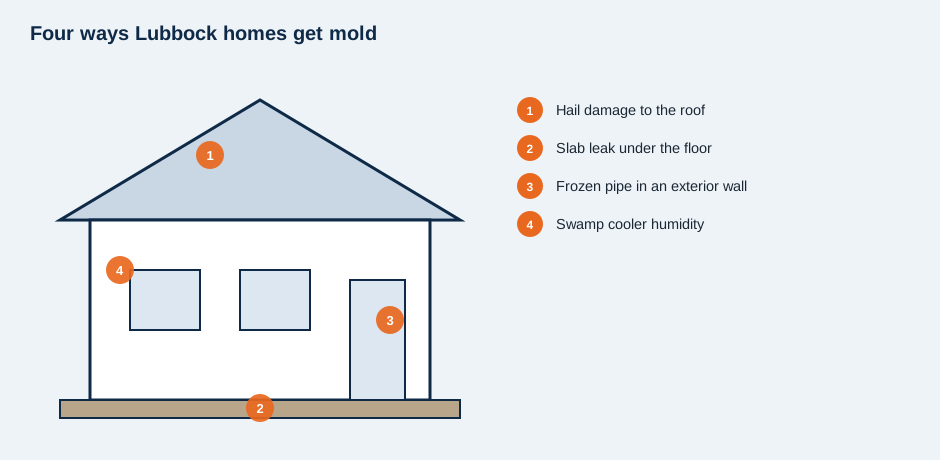
Mold in West Texas does not come from the weather. It comes from water that got somewhere it should not be, inside a building, where the dry outside air cannot reach it. Four sources cover almost everything a contractor sees on a South Plains job.
Plumbing leaks under slabs
Most of Lubbock is built slab-on-grade. There is no crawl space to catch a leak and no basement to check. When a supply line under that concrete fails, water spreads sideways and wicks up into the bottom of the drywall, the tack strip and the carpet pad. You may never see standing water. You will smell it in about three weeks.
The soil makes it worse. Caliche and expansive clay swell and shrink with moisture, and that constant movement stresses plumbing joints and cracks slabs. That is how a small leak turns into a real one.
Hail damage to roofs
The South Plains is one of the highest hail-frequency areas in the country. Storms come through March into June and put golf-ball hail on Lubbock County roofs on a regular basis. Plenty get replaced. Plenty do not, because the damage was borderline or the claim never got filed.
A bruised shingle does not leak that week. It leaks eight months later during a long soaking rain, and the water goes into the attic where nobody is looking.
Hard freezes and burst pipes
Every few winters a freeze breaks pipes across the whole city at once, and smaller versions happen most years. The mold job does not come from the burst. It comes from the repair, where a plumber fixes the line, a box fan runs for two days, the carpet feels dry, and the wall cavity and bottom plate never get dried.
Evaporative coolers and HVAC condensation
Swamp coolers work well in dry air and they are cheap to run, and they put a lot of moisture into a house on purpose. Run one in a house that has been tightened up with new windows and insulation and that humidity condenses on the coldest surfaces available: north-facing exterior walls and closet corners.
Refrigerated air has its own version. A clogged condensate drain or a rusted pan on an attic air handler drips onto ceiling drywall and spreads a long way before you see a stain.
Signs You Should Call
- A musty smell you cannot trace, especially in a closet, hallway or near a floor vent
- Black, green or gray spots spreading on drywall, grout, ceiling or trim
- A warm spot on the floor, or a water bill that jumped for no reason
- Carpet or baseboard along one wall that never seems to dry
- Bubbling paint, staining, or drywall that feels soft
- A ceiling stain, whether or not it is still growing
- Floors that feel soft or springy near a bathroom or the kitchen
- Anyone in the house with a cough, congestion or headaches that clear up when they leave for a few days
- Any pipe break, roof leak or appliance failure in the last year that nobody professionally dried
What the Contractor You're Matched With Does
Caprock Mold Pros connects you with a full-service mold and water damage contractor: someone who finds the water, stops it, removes what cannot be saved, dries the structure, and puts it back together.
Services Covered
- Mold inspection and testing — Free visual inspection, moisture mapping and thermal imaging. Lab sampling when it genuinely helps.
- Black mold removal — Sealed containment, negative air, full removal to Texas standards.
- Attic mold removal — Roof decking cleaning, insulation replacement, ventilation correction.
- Crawl space mold removal — Joist and subfloor cleaning, vapor barriers, drainage.
- Bathroom and shower mold — Behind-tile moisture checks and proper rebuilds.
- Air quality testing — Independent lab analysis against a same-day outdoor control.
- Water damage cleanup and drying — Emergency extraction, commercial dehumidification, daily moisture logging.
- Mold damage repair and reconstruction — Drywall, texture, tile, flooring and trim, matched to what is there.
- Commercial mold remediation — Offices, retail, restaurants, rentals, warehouses and ag buildings.
How the Job Goes
1. Free inspection. The contractor comes out, walks it, takes moisture readings, and tells you what was found in plain language. No charge, no pressure.
2. Written scope and price. Before anything starts, you get a document that says what the work involves and what it costs.
3. Stop the water. This is always first. Remediation without fixing the source is money set on fire.
4. Contain it. Plastic sheeting, sealed access, and HEPA-filtered negative air exhausted outside so nothing spreads into the rest of the building.
5. Remove and clean. Porous material with growth comes out bagged. Framing and hard surfaces get HEPA vacuumed, abrasively cleaned and treated.
6. Dry it. Commercial dehumidifiers and air movers, with daily readings logged until materials hit dry standard against a control.
7. Verify and rebuild. On regulated projects an independent licensed assessor performs clearance. Then the space gets put back the way it was.
Texas Rules, Plainly
The Texas Department of Licensing and Regulation governs mold work in this state, and the threshold that matters is 25 contiguous square feet of affected area.
Under that, no license is required and homeowners can do their own work. At or above it, the remediation has to be done by a licensed Mold Remediation Contractor working from a protocol written by an independent licensed Mold Assessment Consultant, and that assessor performs clearance and issues a Certificate of Mold Damage Remediation. The assessor and the remediator cannot be the same company. Landlords and commercial owners get no homeowner exemption.
Note that the 25 square feet counts the full area requiring cleaning and treatment, not just the visible growth, so small-looking jobs cross the line more often than people expect. The contractor you're connected with will tell you honestly which side yours falls on.
Why Homeowners Here Use This Line
The phone gets answered. Day, night, weekend, holiday. Water damage does not keep business hours, and the contractors in this network take emergency calls.
The inspection is free and so is the honest answer. If what you have is surface mildew and a bath fan that needs replacing, that is what you'll be told, and no work will be pushed on you that you don't need.
The cause gets fixed, not just the symptom. Nearly every "the mold came back" story is a water source nobody addressed.
Written scope, written price. Nothing gets added at the end.
Local knowledge. Slab-on-grade construction on caliche and clay, hail-beaten roofs, swamp coolers, attic air handlers, and older pier and beam stock around the university. That is what the contractors in this network work on every week.
Serving Lubbock and the South Plains
Lubbock, Wolfforth, Shallowater, Idalou, New Deal, Slaton, Abernathy, Ropesville, Smyer, Anton, Levelland, Brownfield and Post. Same rates everywhere, no travel charges.
Call (806) 552-9258 and we'll connect you with someone who will come look at it. Free.
Common Questions About Mold Remediation and Mold Removal
Do you do the mold work yourselves?
No. Caprock Mold Pros is a free referral service. We take your call, ask what you are seeing, and connect you with an independent, licensed mold remediation contractor who works in Lubbock and the South Plains. You hire that contractor directly, and you see their credentials, their price and their scope in writing before you agree to anything.
Is a contractor really reachable at 2 a.m.?
Yes. Water damage and mold emergencies do not wait for business hours, and the first 24 to 48 hours after water gets into a building decide whether it stays a drying job or turns into a remediation job. Call this line whenever it happens and we will get your information to a contractor who handles emergency calls.
Is the inspection actually free?
Yes. The contractor you are connected with provides a visual inspection, moisture readings, thermal imaging and a straight answer about what you have, at no charge, anywhere in the service area. Lab testing is separate and is quoted before any sample is collected.
How much does mold remediation cost in Lubbock?
It depends on how much area is affected, where it is, what material has to come out, and whether the job crosses the 25 contiguous square foot line that triggers licensed remediation under Texas rules. Anyone quoting a number over the phone without seeing it is guessing. The contractor you are matched with gives you a written scope and price after a free inspection.
Can I just clean it myself?
Sometimes. If the affected area is small, it is on a hard non-porous surface like tile, and you know where the water came from and have fixed it, cleaning is reasonable. If it is on drywall, wood, insulation or carpet, or if it keeps coming back, cleaning will not solve it because the roots and the water source are still there.
How fast does mold start growing after water damage?
Under normal indoor conditions, growth can begin in roughly 24 to 48 hours. That is why emergency drying exists as a service and why calling immediately after a leak matters so much.
Will my insurance cover this?
It depends on the cause. Texas policies typically cover mold resulting from a sudden, accidental, covered water event such as a burst pipe. They typically exclude mold from long-term seepage, poor maintenance or flooding. Reporting and documenting it quickly improves your position considerably.