 Caprock Mold Pros
Black mold removal in Lubbock, TX is not a bleach-and-paint job. If you have black growth spreading on drywall, framing, or under flooring, spraying it and covering it up makes the problem invisible, not gone. Caprock Mold Pros connects you with a contractor who removes it properly: seal the area off, control the air, take out what cannot be saved, dry what is left, and kill the water source that started it. Free inspection, and this line answers the phone at any hour.
What People Mean by Black Mold
When somebody calls about black mold, they usually mean Stachybotrys chartarum. It is a dark greenish-black mold that grows on wet cellulose material, which is a technical way of saying wet drywall, wet paper facing on insulation, and wet wood. It needs a lot of water and it needs that water for a while. That is why it follows slow leaks rather than spills.
Here is what a straight-shooting contractor will tell you. Plenty of harmless molds are also black. Cladosporium is black and it grows on window sills. Alternaria is dark and it lives in shower grout. You cannot tell them apart by eye, and anybody claiming to identify a species from across the room is selling something.
The important part: the plan is the same either way. Any mold growing indoors means water is getting somewhere it should not. Remove the growth, remove the water, and it does not matter what a lab would have called it. If you want the species identified for medical or legal reasons, contractors handle that through air quality testing and independent lab work.
Bleach does not fix mold on porous material. It is mostly water. On drywall and wood it soaks in, feeds the material more moisture, and leaves the roots alive under the surface. The stain goes away. The colony does not.
Where Contractors Find It in Lubbock Homes
Every city has its patterns. Here are ours.
Behind the wall on a slab leak
Most of Lubbock is slab-on-grade. Water lines under that slab fail, especially in older parts of town and especially where clay and caliche soils have moved enough to stress the joints. Water spreads under the slab and wicks up into the bottom of the drywall. The first sign is usually a warm spot on the floor, an unexplained water bill, or carpet that stays a little damp along one wall.
By the time it smells, there is growth on the back of that drywall from the floor up eighteen inches or more.
The bottom of a north-facing exterior wall
Evaporative coolers put a lot of moisture in the air. In an older house with the windows closed, that moisture condenses on the coldest surfaces, and in Lubbock that means north-facing exterior walls. Push a bed or a dresser against that wall and you have made a cold, still, damp pocket. That is where the black spots start.
Under the kitchen sink and the hall bath vanity
Slow supply-line drips and rotted P-traps. The cabinet floor turns dark, then soft, then it spreads into the wall behind it. This is the single most common black mold call contractors get. More on the bathroom and shower mold page.
Attic decking after hail
Spring hail across the South Plains bruises shingles that do not fail right away. Eight months later a two-day rain finds the weak spot. Water tracks down the decking and soaks the batt insulation. In summer that attic runs hot and humid and it grows fast. See attic mold removal.
Around the air handler and the return
Condensate lines clog. Drain pans rust through. Attic-mounted units drip onto ceiling drywall. The return air chase pulls whatever is growing there and distributes it to every room, which is why people say the whole house smells musty and they cannot pin down where.
Why You Cannot Wait On This
Two reasons. Health and money.
On health: nobody needs scare stories, and contractors are not doctors. What contractors can tell you from doing this work is that people with asthma, allergies, immune problems, small children and older folks in the house have a rough time with a live mold colony indoors. The pattern contractors hear over and over is somebody feels bad at home and fine on vacation. If that is your household, take it seriously.
On money: mold spreads on a curve, not a line. Left alone with the water still running, a colony under one sink becomes the cabinet, then the wall, then the framing and the floor. What could have been a one-day job turns into containment, demolition, disposal, drying, and a rebuild. Same leak. Very different invoice.
And there is the insurance clock. Texas carriers exclude a lot of mold damage outright and cover the rest only when it results from a sudden, accidental water event you addressed promptly. The longer you sit, the easier it is for an adjuster to call it long-term neglect and deny the whole thing.
The Black Mold Removal Process
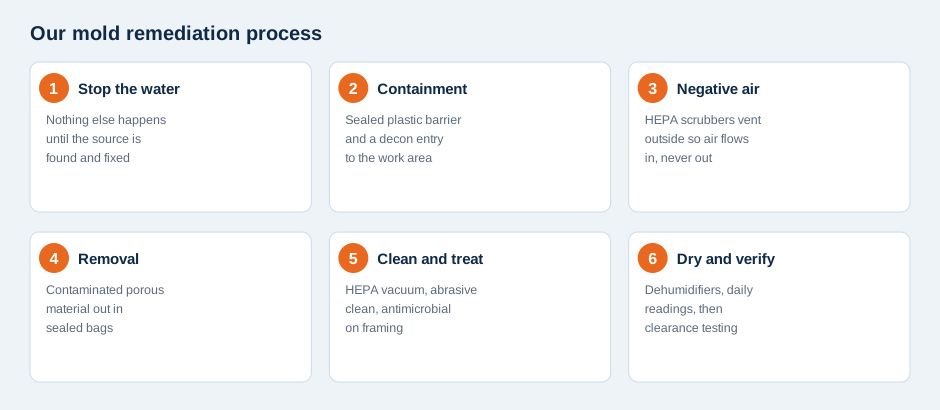
Step 1: Find and stop the water
Nothing else happens first. Removing growth and leaving the leak means the same problem returns in ninety days. Contractors locate the source with moisture meters and thermal imaging, then either repair it or coordinate the plumbing or roofing repair with you.
Step 2: Containment
Contractors seal the work area off from the rest of the house with plastic sheeting and tape, and contractors build a decontamination entry. On projects over 100 square feet, Texas rules call for double containment barriers. Nobody tracks spores through your living room.
Step 3: Negative air
Air scrubbers with HEPA filtration pull air out of the containment and exhaust it outside. That puts the sealed area under negative pressure, so air flows in and never out. This is the step cheap operators skip, and it is the reason their customers end up with mold in three other rooms.
Step 4: Removal
Porous material with growth on it comes out. Drywall, insulation, carpet pad, ceiling tile, particle board cabinet bases. It gets bagged inside containment and carried out sealed. Semi-porous and non-porous material like framing, studs, concrete and tile gets cleaned rather than removed, with HEPA vacuuming, detailed abrasive cleaning and antimicrobial treatment.
Step 5: HEPA cleaning
Every surface inside containment gets HEPA vacuumed and wiped. Spores are microscopic and they land on everything, which is why the cleaning footprint is always bigger than the visible growth.
Step 6: Dry it out
Commercial dehumidifiers and air movers run until the framing and remaining material read normal moisture content. Contractors monitor daily. Drying is not done when it feels dry, it is done when the meter says so.
Step 7: Clearance and rebuild
On regulated projects, an independent licensed assessor performs post-remediation verification and issues the certificate. Then contractors can put the house back together, which is covered on the mold damage repair and reconstruction page.
Texas Licensing Rules in Plain English
The Texas Department of Licensing and Regulation sets the rules for mold work in this state. Here is what matters to you.
- Under 25 contiguous square feet of affected area, the state does not require a licensed remediator. You can hire anyone, or do it yourself in your own home.
- At 25 contiguous square feet or more, a licensed Mold Remediation Contractor has to do the work, and a licensed Mold Assessment Consultant has to write the protocol and check clearance. Those two have to be separate companies.
- That 25 square feet counts the whole area needing cleaning and treatment, not just the visible spots.
- Homeowners are exempt on their own residence. Landlords, property managers and commercial owners are not.
Contractors will tell you honestly where your job lands.
What Black Mold Removal Costs in Lubbock
Anyone who quotes you over the phone without seeing it is guessing. That said, here is what actually drives the number.
- How much area is affected. Square footage of contaminated material is the single biggest factor.
- Where it is. A vanity cabinet is straightforward. An attic in July, or a crawl space you have to belly-crawl through, is not.
- What has to come out. Drywall is cheap to replace. Custom cabinetry, hardwood and tile are not.
- Whether the structure is affected. Growth on framing means cleaning and treating rather than replacing, which takes labor.
- Whether the job is regulated. Over 25 square feet you are paying for containment, negative air, an independent protocol and clearance testing.
- The repair that caused it. Slab leak repair, roof repair and HVAC work are separate from the mold work itself.
You get a written scope and a written price before contractors start. Nothing gets added at the end.
Serving Lubbock and the South Plains
Contractors work all over Lubbock, from the older homes in Tech Terrace and the streets around Texas Tech, through the neighborhoods inside Loop 289, out to the newer builds south of 98th and west toward Milwaukee Avenue, and up the I-27 corridor. Contractors also cover Wolfforth, Slaton, Shallowater, Idalou, Levelland, Brownfield and more.
Call (806) 552-9258. Free inspection, and somebody picks up.
Common Questions About Black Mold Removal
Is black mold dangerous?
Any active mold colony indoors is a problem, and people with asthma, allergies, weakened immune systems, small children or elderly family members tend to react worst. Contractors are remediation contractors, not physicians, so contractors will not diagnose anyone. What contractors will tell you is that if people feel better when they leave the house, that is worth acting on.
Can I just spray it with bleach?
On hard non-porous surfaces like tile or glass, bleach can handle a surface film. On drywall, wood, insulation or carpet it does not work. Bleach is mostly water, it soaks into the material, and the roots survive under the surface while the stain disappears. You end up with a hidden colony and a wetter wall.
How long does black mold removal take?
A small contained job under a sink or in one bathroom is often one to two days plus drying time. A whole-room job with containment, negative air, demolition and structural drying usually runs three to five days before rebuild. Attic and crawl space jobs vary widely depending on access.
Do I have to move out during the work?
Usually not. That is the entire point of containment and negative air. Contractors seal the work zone off and exhaust it outside so the rest of the house stays livable. If the affected area includes the only bathroom or the kitchen, or if somebody in the house has serious respiratory issues, staying elsewhere for a couple of nights is the easier call.
Will my homeowners insurance cover it?
It depends on the cause and the policy. Texas policies typically cover mold resulting from a sudden, accidental, covered water event such as a burst pipe in a freeze. They typically exclude mold from long-term seepage, poor maintenance, or flooding. The faster you report and document it, the better your odds.
Do you fix the leak too, or just the mold?
Contractors locate the water source on every job, because remediation without that step is a waste of your money. Depending on what it is, contractors either handle the repair or coordinate directly with the plumber or roofer so the sequence is right and nothing gets closed up wet.
How do I know it is really gone?
On regulated projects an independent licensed assessor performs post-remediation verification and issues a Certificate of Mold Damage Remediation. On smaller jobs contractors document moisture readings back to normal levels and can arrange independent clearance testing if you want the paperwork.
Why does it keep coming back in the same spot?
Because the water source was never fixed. That is the answer more than nine times out of ten. Recurring growth in one location means an active leak, a condensation problem, or a drainage issue nobody has addressed.